
The Facilitators’ Muse™ (TFM) is a privately owned knowledge-development business and living knowledge ecosystem created by Helen Wythe. It transforms reflective practice into practitioner knowledge—and practitioner knowledge into improved facilitation practice.
Through reflective inquiry, Action Research, publications, learning experiences, and professional dialogue, TFM creates opportunities for facilitators, emerging practitioners, and professionals exploring facilitation to examine practice, test ideas, develop practical knowledge, and contribute to the continuing development of group process facilitation. This work is grounded in lived inquiry—the ongoing cycle of experience, reflection, and refinement that shapes true professional mastery.
Why The Facilitators’ Muse™ Exists
Facilitation is a practice profession. Professional judgement develops over time through experience, reflection, inquiry, learning, dialogue, and continued application. The Facilitators’ Muse™ exists to create a place where that learning can be made visible, examined, developed, shared, and returned to practice.
It begins with a simple premise: professional knowledge is constructed rather than simply acquired.
Every reflective practitioner has the potential not only to improve their own practice, but also to contribute to the profession’s evolving body of knowledge.
How Knowledge Grows at The Facilitators’ Muse™
Practice generates experience. Experience creates opportunities for reflection. Reflection raises questions worthy of inquiry. Inquiry generates insights that can strengthen practice. Improved practice creates new experience—and the cycle begins again.
Experience → Reflection → Inquiry → Improved Practice → New Experience
Inquiry involves activities such as: Action Research • Community Conversations • Literature Review
Balancing inquiry with:
* practical realities of meaningful change and the discipline of staying with complexity;
* reflection, relationship, and discernment for what wants to emerge;
* invisible work that helps people and groups think, relate, and move forward together.
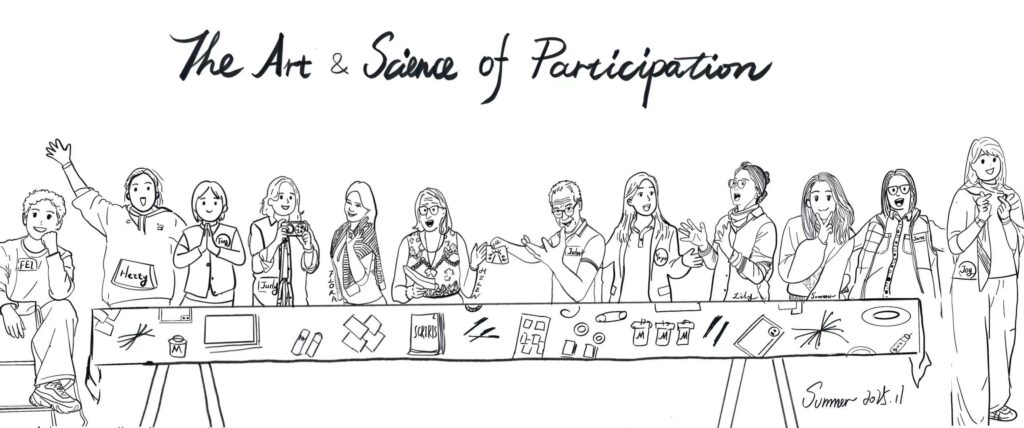
A glimpse of my facilitation training, coaching, and mentoring work in China in 2025. I will be heading back to China in May 2027 to deliver this life-changing course to amazing facilitators.
This sketch is the amazing work of my friend and colleague, Summer Li – summer.li@chuangfuwh.com
What The Facilitators’ Muse™ Does
Reflective Edge™
Thought-provoking questions, quotations, dilemmas, stories, and provocations that invite practitioners to examine assumptions and explore the edges of professional practice.
Action Research
Structured practitioner inquiry into real questions arising from facilitation practice.
Publications
Articles, essays, research findings, frameworks, practitioner resources, and other ways of capturing and sharing emerging knowledge.
Learning Experiences
Thoughtfully designed opportunities to explore ideas, reflect on experience, develop professional judgement, and apply learning to practice. Pathways to Clarity: Exploring the Encore Career Path™ is the first such opportunity for facilitators and facilitation-curious professionals.
Together, these activities help turn individual experience into shared practitioner knowledge and shared knowledge back into improved practice.
Our View of Professional Facilitation Practice
TFM distinguishes between facilitation as a broader capability, group process facilitation as a professional discipline, and professional facilitation practice as the skilled application of that discipline.
Facilitation: The broader activity or capability of helping people think, work, learn, decide, and collaborate more effectively.
Group process facilitation is the professional discipline concerned with designing and guiding participatory processes through which groups think, communicate, learn, make meaning, reach decisions, and act together.
Professional facilitation practice: The skilled application of that discipline, drawing on professional knowledge, competencies, ethics, judgment, reflective capacity, and experience.
TFM explores both the visible dimensions of professional practice—methods, processes, designs, and outcomes—and the less visible dimensions of judgment, presence, relationships, ethics, reflection, and the conditions that enable meaningful participation.
This perspective treats facilitation as more than the competent use of methods. It is a reflective professional practice requiring discernment about what a group, a context, and a moment are asking of the facilitator.
The Philosophy Behind TFM
TFM is grounded in several enduring ideas:
Facilitation is a practice profession.
Professional knowledge is constructed rather than simply acquired.
Professional wisdom develops by integrating experience, reflection, research, dialogue, education, and inquiry. These different forms of learning contribute to more thoughtful and discerning practice.
Professional growth is a lifelong spiral of learning, judgment, wisdom, and contribution: Facilitators continue to refine judgment, deepen wisdom, question assumptions, and contribute to the profession’s evolving knowledge.
By attending to:
- reflective inquiry
- relational depth
- thoughtful design
facilitators enable themselves to think deeply, relate authentically, and act with collective wisdom
Values That Guide the Work
TFM’s work is guided by nine interconnected values: Curiosity, Reflective Practice, Participation, Collective Wisdom, Stewardship, Integrity, Courage, Practical Wisdom, and Continuous Learning.
Together they describe not simply how knowledge is developed, but the professional character through which that knowledge is created, shared, and applied.
About the Founder – Helen Wythe C™PF|M, CT™F, C-IQ™

Helen Wythe is the founder of The Facilitators’ Muse™ and an Independent Facilitation Consultant with more than 30 years of experience in professional group process facilitation. Real-world facilitation successes and failures have shaped her approach as much as by formal models and methods. Rather than focusing solely on tools and techniques, she is interested in how facilitators learn to steward process with discernment, relational awareness, and care.
While grounded in established participatory methods and professional facilitation practice, including extensive experience with the Technology of Participation (ToP™) methods as a practitioner, trainer, mentor, and assessor, her current work increasingly explores the reflective and less visible dimensions of the work—judgement, presence, relationships, conditions for participation, and the ongoing development of professional wisdom. Alongside her facilitation practice, she has supported the development of facilitators and contributing to the continuing growth of the profession.
Throughout her career, Helen has worked across healthcare, government, not-for-profit, community, education, science, and corporate settings, designing and facilitating participatory processes that help groups think together, navigate complexity, make decisions, and move toward meaningful action. Her work has taken her from local and community settings to national and international engagements.
Her efforts are based on a lifetime of experience working with:
* people, teams, large groups, communities, organizations, and multi-stakeholder groups to navigate complexity, strengthen participation, and create meaningful pathways forward together;
* cross-sector initiatives, leadership teams, and distributed networks navigate transitions through a thoughtful process that considers the human dimensions of collaborative work.
She has become particularly interested in reflective practice, professional maturation, and the capacity to work with what is emerging — not simply what is planned. Across these roles, Helen has become increasingly interested not only in how facilitation is done, but in how facilitators learn, develop professional judgement, create knowledge from experience, and contribute that knowledge back to the profession. The Facilitators’ Muse™ grew from that interest. It represents the next chapter of Helen’s professional work.
A Next Chapter
The Facilitators’ Muse™ brings together more than three decades of facilitation practice, teaching, mentoring, inquiry, experimentation, and reflection into a living body of practitioner knowledge.
TFM is not intended simply to preserve what Helen has learned over the course of her career. It creates a place where experience can become a starting point for further reflection and inquiry—where ideas can be questioned, tested, refined, connected with the experience and knowledge of others, and returned to practice.
Through Reflective Edge™ inquiries, Action Research, publications, professional conversations, and learning experiences, Helen is using TFM to explore questions that have emerged from practice while inviting other practitioners to contribute their own experience, perspectives, questions, and discoveries.
In this way, accumulated experience becomes more than personal expertise. It becomes something that can be examined, developed, shared, and used in service of others. Her work is shaped by more than facilitation practice, mentoring, and assessment. She has seen people enter this field for reasons that do not sustain them, and others thrive because the work fits who they are deeply. Increasingly, she feels called to help people discern that difference with honesty and care.
For Helen, this is the deeper purpose of this next chapter: to steward what has been learned, remain curious about what is still to be discovered, and contribute to an evolving body of practitioner knowledge that can strengthen professional facilitation practice for those who follow.
As she continues to explore facilitation not simply as a set of methods, but as a lifelong practice of presence, discernment, and meaningful human collaboration.
What It’s Like to Work Alongside Helen – A Practitioner Perspective
Working with Helen has been instrumental in my journey of stepping fully into — and truly embracing — my role as a professional facilitator. Over the years, she has been far more than a mentor. She’s been a trusted sounding board for design ideas, a partner in thoughtful back-and-forth on facilitation approaches, and an incredibly generous provider of resources, templates, and insights.
Helen has a unique ability to say exactly what needs to be heard — whether that’s reaffirming my capabilities, offering a new lens on a design challenge, or simply prompting deeper thinking with a well-timed ‘have you considered this?’ Her questions consistently push me to grow, and I’ve always known I had someone firmly in my corner — a true ‘phone-a-friend’ when it mattered most.
What sets Helen apart is not just her skill, but the example she sets. Her early leap into full-time facilitation and the remarkable career she’s built has given me a deep appreciation for the craft and what’s possible within it. She has been a true inspiration in helping me discover my own calling as a facilitator.
I genuinely feel like I’m standing on the shoulders of a giant — able to see farther because of her influence — and it’s a privilege to continue learning and growing alongside her.
Riley Beauchamp, IAF /C™PF, ICAA Advanced Facilitator Program Graduate; Continuous Improvement Facilitator
Explore The Facilitators’ Muse™
TFM is a living system. Its ideas develop through reflection, inquiry, conversation, research, writing, and application in practice.
Explore the Reflective Edge™
Explore Action Research
Read Publications / Blog
Explore Learning Experiences
For those reconsidering their next chapter — or feeling drawn toward more meaningful facilitation work — Pathways to Clarity: Exploring the Encore Career Path™ offers a thoughtful process for discerning what is truly yours to do now.
A Note On My Writing Process
I use generative AI as one of several tools to develop this article—to help me research, explore ideas, compile data, test structure, and refine language. The questions, professional perspectives, interpretations and conclusions are my own, and I take responsibility for the final text.
The Facilitators’ Muse™ is a continuing conversation about facilitation practice—what we experience, what we question, what we are learning, and what we can contribute to the profession.
Click below to stay connected and receive updates on new reflections, inquiries, publications, and learning opportunities.