
How the language of “buy-in” can undermine agency, participation, shared ownership, and genuine commitment.
The phrase “We just need buy-in” is uttered in countless meetings—but what if the very language we use is undermining the very outcomes we seek?
To me, this phrase signals an imbalance of power and participation. When I hear it, it feels like a one-ton rock lands in my stomach. I immediately feel uneasy and wary about the speakers’ intent and values. Over the past decade, I’ve reflected on why I reacted so strongly to this phrase and how it has affected the groups I facilitate. The more I thought about it, the more I noticed how the assumptions and cultural associations this phrase carries can reveal a worldview centred on power dynamics and persuasion.
Over the past couple of years, I have noticed the phrase becoming increasingly commonplace among leaders in human services and not-for-profit organizations, particularly when describing how they want to engage employees in organizational transformation. Each time I heard it, I found myself questioning what assumptions about participation and decision-making were sitting beneath the language.
When I began hearing group process facilitators, I was training use the term to describe gaining people’s support for organizational initiatives, my concern deepened. It prompted me to examine more closely what the language of “buy-in” might signal about our understanding of participation—and ultimately led to this article. When facilitators adopt this terminology uncritically, they risk reinforcing a dynamic in which decisions are made in advance, and participants are invited only to endorse—not shape—them.

The language of “buy-in” is so embedded in our professional vocabulary that we may no longer notice it. SessionLab’s State of Facilitation 2025 survey, for example, included “Getting buy-in from stakeholders” among the challenges facilitators were asked about; 16.5% of respondents selected it. The following State of Facilitation 2026 report continued the language, identifying “low participant buy-in” among barriers to facilitation (as) having an impact.
I find this worth pausing over—not as a criticism of SessionLab, but because it illustrates just how normalized the language has become within our own profession. Even in a field fundamentally concerned with participation, we describe one of our challenges as getting people to “buy in.”
Perhaps the more useful question is not, How do we get stakeholder ‘ buy-in ‘?” but, What conditions would enable stakeholders to exercise meaningful agency, contribute to the decisions that affect them, and develop genuine, shared commitment to what emerges?
That distinction is central to this article. I want to invite facilitators to look more closely at the language we use and the assumptions it carries about power, participation, and decision-making. If our practice is intended to foster agency, meaningful participation, and shared ownership, then our language should reflect those commitments.
So, What Is My Issue with the Phrase “Buy-In”?
My issue with “buy-in” begins with the metaphor itself. The phrase carries a distinctly transactional logic: someone already has an idea, direction, or decision, and someone else is being asked to accept or support it. It connotes persuasion rather than participation.
When “buy-in” is used this way, participants may be positioned less as contributors to the decision and more as people whose support needs to be gained; the facilitator can then be drawn into a persuasive rather than participatory role. This approach:
- Frames participants as consumers, not co-creators
- Implies persuasion over participation
- Undermines authentic engagement and inclusion
Cialdini’s principle of commitment and consistency suggests that once people make a choice or take a position, they are more likely to behave in ways that remain consistent with that commitment (Cialdini, 1984).
The language of “buy-in” can also reinforce patterns associated with patriarchal and authoritarian leadership systems, where authority and decision-making are concentrated at the top. In these systems, leaders set the direction, and those with less positional power are expected to accept, support, and implement it. “Buy-in” fits remarkably comfortably within that worldview: we decide; you agree. Participation may occur, but only after the decision boundaries have already been established.
This matters because facilitation can create a very different relationship with power. Rather than asking, How do we get people to support our decision? a participatory approach asks: Who needs to have a voice? Where should decision-making authority reside? What is genuinely open to influence? The shift moves from compliance and persuasion to agency, contribution, and shared responsibility.
The Technology of Participation™ (ToP™) Ladder of Involvement in Decision-making (Canadian Institute of Cultural Affairs, 2012) distinguishes eight levels of involvement. Persuasion sits at Level 2, near the very bottom of the Ladder. At this level, people are “encouraged to agree or give consent to decisions,” often by highlighting the benefits, advantages, or significance of a decision already made.
This distinction matters. Persuasion is not participation in the decision itself. Participants have not helped define the issue, explore possibilities, weigh alternatives, or decide. As involvement increases up the Ladder, their role changes substantially: they may provide input about implementation, contribute ideas considered in decision-making, assume responsibility for implementation, exercise defined decision-making authority, and, ultimately, take full responsibility for the situation, project, or organization.
This does not mean persuasion is always inappropriate. Sometimes a decision has legitimately been made, and the task is to explain it, educate people about it, or encourage support. The problem arises when we call that participation—or use a participatory process to create the appearance that people have influence they do not actually have. I call this “facipulation”: using the appearance or methods of facilitation to manipulate people toward a predetermined outcome. The Ladder reminds us that one of the facilitator’s responsibilities is to understand what kind of decision or outcome is appropriate for the group on each topic—and to be transparent about the level of influence participants actually have.
Language is Seldom Neutral
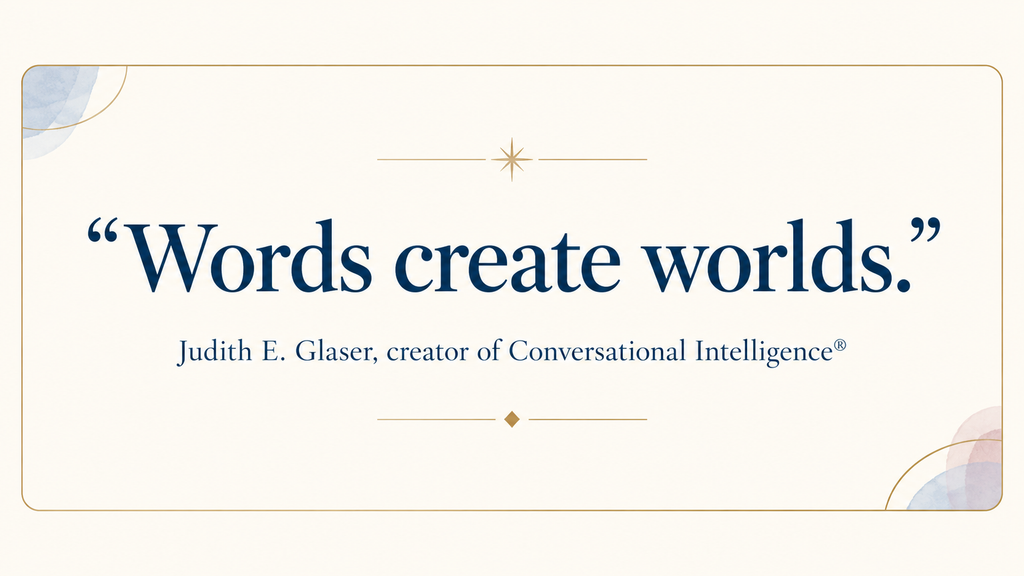
Judith E. Glaser, creator of Conversational Intelligence®, often said, “Words create worlds.” (as cited in Balboa & Glaser, 2019).
Her work was grounded in the understanding that conversations do more than exchange information; through language, people construct meaning, relationships, trust, and a shared sense of reality. Conversational Intelligence describes our conversations as shaping how we connect, engage, and navigate with one another.
This is precisely why the language of “buy-in” deserves our attention. Words do not simply describe a participatory process; they can help create the conditions within which participation occurs. “Buy-in” can frame one person as the holder of an idea and another as the person expected to accept it. If words create worlds, then facilitators might ask: What kind of world are we creating when we ask people to buy in? Who owns the idea? Who gets to shape it?
Terms such as “alignment,” “rollout,” “champions,” “tracking,” and “buy-in” can reflect a top-down approach to decision-making, depending on how they are used. They can reveal who holds the authority to initiate change and who is expected to accept, support or implement it. Facilitators must become attuned to how these words shape the dynamics in the room.
As Brenda J. Allen notes in Difference Matters: Communicating Social Identity, language reflects and reinforces existing social hierarchies (Allen, 2010).
There is also a psychological and neurological dimension to what happens when people perceive they are being persuaded rather than genuinely invited to participate. Research on psychological reactance shows that language experienced as controlling or threatening to autonomy can evoke anger, negative thinking, and resistance (Li & Shi, 2026). Research on acute stress suggests that working memory and cognitive flexibility can be impaired under stress, potentially reducing cognitive capacities important for reflective participation (Shields, Sazma, & Yonelinas, 2016).
Over the years, I have become increasingly attentive to what happens in a room when the phrase ‘buy-in’ is used. I have felt the emotional tone shift to mistrust, and I have seen people’s faces shift to hesitancy and uncertainty.
Context, relationships, previous experience, and power dynamics all matter. If “buy-in” communicates that the decision has already been made and now we need you to agree, it can threaten precisely what meaningful participation requires: autonomy, psychological safety and trust. Instead of inviting inquiry, contribution, and shared responsibility, we may inadvertently invite defensiveness, silence, compliance, or resistance.
What Are We Really Asking for When We Say “Buy-In”?
Let’s begin by examining the phrase itself. When leaders say, “We need their buy-in,” what are they really seeking—agreement, acceptance, support, commitment, compliance, ownership, or willingness to implement? These are not the same thing. If we really want agency, participation, shared ownership, and genuine commitment, why settle for “buy-in”?
Instead of defaulting to compliance, facilitators can help clarify the level of involvement that is genuinely available by asking, ‘What would meaningful involvement look like in this situation, and what is actually open to influence?’
If my client contact talks in terms of “buy-in,” I inquire further. What decision has been made that you want people to agree to? If a decision has been made, I suggest they own it, and I support them by helping them provide context and supporting the team in determining what that means for how they do their work. If a decision has not been made, I ask follow-up questions to clarify what they want and the level of participation they are genuinely prepared to offer.
Where genuine participation is intended, I encourage language that more accurately describes the invitation, such as:
- Co-create
- Shape together
- Involve
- Partner
- Explore
- Decide together
Several facilitation frameworks support this shift:
• Technology of Participation (ToP™): Encourages inclusive dialogue, collective sense-making, and participatory decision-making through structured methods such as the Focused Conversation and Consensus Workshop.
• Liberating Structures: Developed by Henri Lipmanowicz and Keith McCandless, Liberating Structures offers a repertoire of participatory methods designed to include and engage more people in shaping discussion, decisions, and action.
• Deep Democracy: The concept originated with Arnold Mindell. The Lewis Method of Deep Democracy, developed by Myrna and Greg Lewis from Mindell’s work, adapts these ideas for organizational facilitation and conflict resolution, with particular attention to surfacing difference and including voices that may otherwise remain unheard.
These frameworks create conditions in which participants can contribute meaningfully rather than simply being asked to endorse a pre-made decision.
Facilitators can unlearn habits that prioritize control and predictability. Reflection questions include:
- When do I use language that centres control?
- How do I react when participants resist or challenge the process?
In How the Way We Talk Can Change the Way We Work, Kegan and Lahey argue that language is the medium through which organizational transformation occurs. Shifting from “selling” to “co-creating” changes the structure of participation (Kegan & Lahey, 2001).
In one not-for-profit organization I worked with, we replaced a traditional town hall approach with a co-design process. The shift gave participants more opportunity to shape the outcome and contributed to a stronger sense of shared ownership. In my experience, implementation of the co-designed action plan was more cost-effective and achieved stronger follow-through than previous attempts using a town hall approach.
Word choices influence who feels included, respected, and empowered. By examining and reframing the language we use, we also help grow the field of facilitation itself. Part of our role as facilitators is to help organizations notice when their language reinforces hierarchy and to support a shift toward language that invites greater participation, agency, and shared ownership.
Jessica Nordell, in The End of Bias: A Beginning, emphasizes that unconscious patterns—including those in language—can be disrupted with intention and awareness (Nordell, 2021).
Facilitation as a discipline committed to meaningful participation must examine the language and practices that may unintentionally reinforce hierarchy. This includes the vocabulary we rely on, often unconsciously. Facilitators who do this reflective work help model the future of inclusive leadership.

Conclusion
The call to move beyond “buy-in” asks practitioners to be intentional about language, conscious of power, and clear about the involvement actually being offered. If we want endorsement, we should say so. If we want participation, we must create genuine opportunities for people to influence the outcome. Rather than shaping people to fit the process, we should shape the process to fit the level of participation we genuinely intend.
Reflection Prompt
- What terms do I use that may unintentionally reinforce hierarchy?
- What new language could invite greater participation and shared ownership?
Language isn’t just how we communicate—it’s how we co-create the future.
Add Your Voice
I’d like to continue developing this inquiry with input from the facilitation community. How does the phrase “buy-in” land for you? What does it signal about participation, power, and commitment?
Take the short survey and add your perspective. Your responses will help shape the next stage of this work.
References
- Allen, B. J. (2010). Difference Matters: Communicating Social Identity.
- Balboa, N., & Glaser, R. D. (2019). Words create worlds. Psychology Today.
- Cialdini, R. (1984). Influence: The Psychology of Persuasion.
- Canadian Institute of Cultural Affairs. (2012). Meetings That Work: Ladder of Involvement in Decision-making.
- Deep Democracy https://deepdemocracyusa.com/
- Glaser, J. E. (2016). Conversational Intelligence: How Great Leaders Build Trust and Get Extraordinary Results. Routledge
- Kegan, R., & Lahey, L. L. (2001). How the Way We Talk Can Change the Way We Work.
- Li, Z., & Shi, J. (2026). Message effects on psychological reactance: Meta-analyses. Human Communication Research, 52(1), 38–52. https://doi.org/10.1093/hcr/hqaf016
- McCandless, K., & Lipmanowicz, H. (2014). The Surprising Power of Liberating Structures: Simple Rules to Unleash a Culture of Innovation. Liberating Structures Press.
- Shields, G. S., Sazma, M. A., & Yonelinas, A. P. (2016). The effects of acute stress on core executive functions: A meta-analysis and comparison with cortisol. Neuroscience & Biobehavioral Reviews, 68, 651–668. https://doi.org/10.1016/j.neubiorev.2016.06.038
- Mindell, A. (2002). The Deep Democracy of Open Forums: Practical Steps to Conflict Prevention and Resolution for the Family, Workplace, and World. Hampton Roads.
- Nordell, J. (2021). The End of Bias: A Beginning.
- SessionLab. (2025). State of Facilitation 2025. https://www.sessionlab.com/state-of-facilitation/2025-report/
- SessionLab. (2026). State of Facilitation 2026. https://www.sessionlab.com/state-of-facilitation/2026-report/